


.jpg)
Revolutionizing Patent Processes: The Rise of AI-Assisted Patent Prosecution
- Aequitas Victoria

- May 23, 2025
- 13 min read
Paper Code: AIJACLAV20RP2025
Category: Research Paper
Date of Publication: May 19, 2025
Citation: Mr. Mohd Abdul Muneim Farzaan, “Revolutionizing Patent Processes: The Rise of AI-Assisted Patent Prosecution", 5, AIJACLA, 220, 220-229 (2025), <https://www.aequivic.in/post/revolutionizing-patent-processes-the-rise-of-ai-assisted-patent-prosecution>
Author Details: Mr. Mohd Abdul Muneim Farzaan, M.Pharmacy University College of Technology (A) Osmania Universitysity
Abstract
The rapid advancement of Artificial intelligence is transforming innovation across industries, including intellectual property (IP). AI generated inventions has become increasingly prevalent worldwide and are reshaping its traditional processes of patent Drafting, examination and enforcement. AI tools predict patentability and automate patent searches with high efficiency. These advancements enable patent professionals enhance their decision making. An AI system generates novel ideas and inventions for intellectual property rights and for patent purposes and it also helps in learning machine modules.
Keywords:-patentability prediction, AI assisted patent prosecution, AI powered patent tools, Novel idea generation, patent strategy.
Introduction
Artificial Intelligence refers to the science of developing computer system that can perform tasks that requires human intelligence like reasoning, problem solving etc. An AI system uses algorithms, data structures and software’s which mimic human cognitive function and decision making.
Patent is a form of intellectual property (IP) that grants the exclusive rights to the owner for his or her invention. Patent protects novel, non-obvious and useful inventions. It also provides a monopoly on the invention which allows the owner to prevent others from producing, generating and selling the invention.
Intellectual property refers to the creations of the mind, including inventions, artistic works, graphics, logos and symbols. It can be protected through various laws and regulations. The World Intellectual Property Organization (WIPO) has enacted laws to safeguard the intellectual property. It allows the creators to profit from their work and prevents imitation. These laws aim to stimulate the economic growth by providing financial incentives for innovation. Patents, copyrights, trademarks, trade symbols are the types of legal protections that enable the creators to gain recognition an financial benefits from their inventions and creations.
The increasing use of Artificial intelligence AI in various industries has significant implications for patent law. The rapid advancement of AI is transforming the patent landscape. AI generated inventions, AI-assisted patent prosecution and AI-powered patent tools are revolutionizing on patent quality, efficiency, innovations and the way patents are created, prosecuted and enforced. AI has the potential to improve patent quality, and efficiency. It raises concerns about transparency, accountability and May introduces bias into patent decisions. AI and patent law identifies the areas Of convergence and potential conflict.
The term AI was coined by John McCarthy at the Dartmouth conference 1956. According to McCarthy, "Artificial Intelligence means science and engineering of making intelligent machine especially intelligent computer programs."According to R Sternberg, "Intelligence is the cognitive ability of an individual to learn from experience, to reason well, to remember well, to remember important information and to cope with demands of daily living.”Anything can be called intelligent if it has general ability to learn, process and to solve problems.
Patent prosecution is the process for obtaining a patent from a patent office with any administrative process, there is a great deal of paperwork and evidence which isrequired to demonstrate to a patent office that an invention is patentable. Patent prosecution is particularly burdensome due to the niche patent language used by practitioners. Errors in drafting can be expensive, difficult, or impossible to correct. For example, an error in a patent claim may limit the scope of an invention and weaken a patent. In drafting responses to office actions, the situation can be far worse, as the "fixed" scope of the invention has already been set forth in the claims. Innovative defensive publication with Al may revolutionize the patent process. The invention is not the Al-generated invention that will be reflected in future issued patents. Instead, the audience switch is on, and the invention is the technique of presenting Al- generated results as prior art. With the advent and widespread deployment of artificial intelligence-assisted patent prosecution, an expanding pool of prior art will be generated.
Half of all patent applications filed are issued as patents. The application may be abandoned or denied during prosecution. Further, patents are only examined in light of prior art that is easily accessible or available to an examiner, which may miss some highly relevant references. In general, a "good" patent application is one in which the invention is deeply non-obvious and substantively different from the closest prior art. Defensive publication (DP) is another strategic action taken by an inventor. Upon publication, a defensive publication invalidates any future issuance of a patent for the described invention if made more than one year from the publication date. Defensive publication with Al is expected to strengthen defense value compared to baseline publication.
Steps Involved in Patent Prosecution
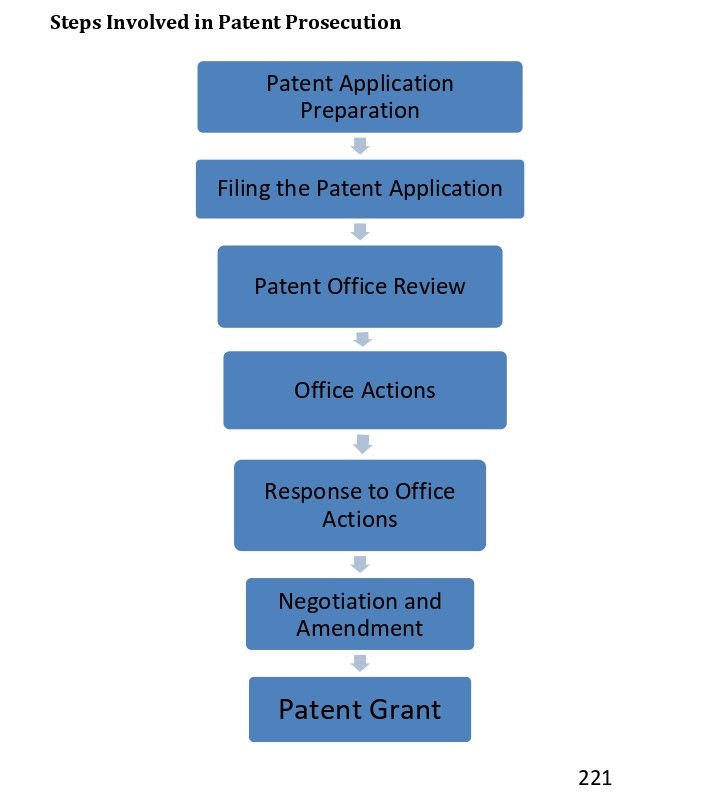
FIG: Steps involved in patent prosecution
1. Patent Application Preparation: The process begins with preparing a patent application, which includes writing a detailed description of the invention, drawing diagrams and figures, and drafting claims that define the scope of the invention.
2. Filing the Patent Application: The patent application is then filed with the patent office, along with the required fees.
3. Patent Office Review: The patent office reviews the patent application to determine whether the invention meets the requirements for patentability, including novelty, non-obviousness, and utility.
4. Office Actions: The patent office issues office actions, which are communications that identify issues or objections with the patent application.
5. Response to Office Actions: The applicant responds to the office actions by addressing the issues or objections raised by the patent office.
6. Negotiation and Amendment: The applicant may negotiate with the patent office and amend the patent application to overcome objections or issues.
7. Patent Grant: If the patent office determines that the invention meets the requirements for patentability, a patent is granted.
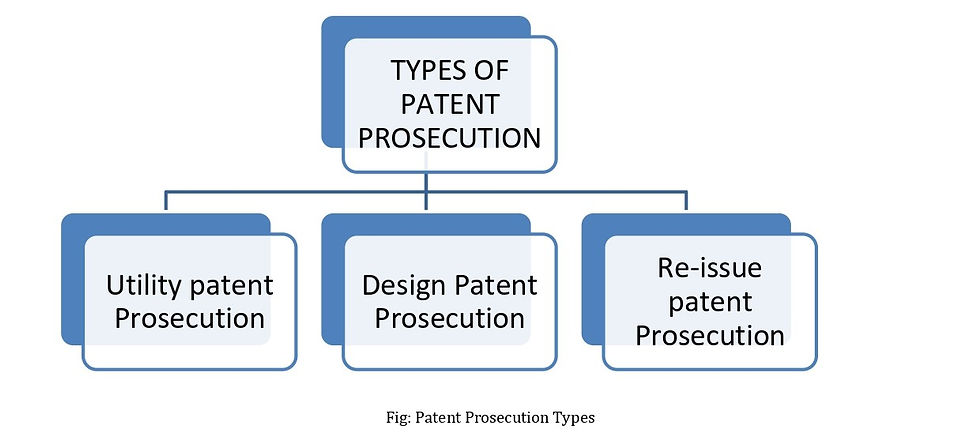
Fig: Patent Prosecution Types
Types of Patent Prosecution
1. Utility Patent Prosecution: This type of patent prosecution involves obtaining a utility patent, which covers functional inventions, such as machines, processes, and compositions of matter.
2. Design Patent Prosecution: This type of patent prosecution involves obtaining a design patent, which covers ornamental designs for functional items.
3. Re-issue Patent Prosecution: This type of patent prosecution involves obtaining a reissue patent, which is a re-examination of an existing patent.

FIG: Patent prosecution Importance
Importance of Patent Prosecution
Protection of Intellectual Property Rights: Patents are protected for unique innovations. Honest and original prosecution ensures the rightful inventor benefits from their creation.
Competitive Advantage: It helps in determining any intentional or accidental plagiarism, and the patent can be revoked if found to be plagiarized.
Monetization of inventions: It is the process of turning intellectual property (IP) into financial gain. It can be done through various strategies, including licensing, selling patents, forming partnerships, or launching a business. Below are the key methods to generate revenue from an invention.
Strengthens the Patent claims: The patent claim can be achieved by utilizing the invention for a useful purpose, and the invention should be non-obvious and novel.
Avoid Litigation Risks: Patent infringement lawsuits is costly and time-consuming. A plagiarized application may result in expensive legal battles with rightful patent holders, financial liabilities, including damages and settlements and Loss of rights to market or commercialize the product.

FIG: Patent Prosecution Challenges
Challenges in Patent Prosecution
1. Complexity of Patent Law: Patent law is complex and nuanced, making it challenging to navigate the patent prosecution process.
2. Legal and procedural barriers: Different countries have different patent laws, which makes the international patent prosecution complex. Missing filing deadlines or procedural requirements can lead to delays or loss of rights.
3. Cost and Time: Patent prosecution can be costly and time-consuming, which requires significant resources and expertise.
4. Hurdles in commercialization: potential patent violations in monitoring the market requires significant resources an Some entities exploit the system by filing lawsuits over weak or questionable patents and Rapid technological advancements and evolution can make patents obsolete before they are even granted.
I. AI-Generated Inventions
AI-generated inventions refer to novel creations developed by AI systems without human intervention. These inventions can take various forms, which includes new materials, devices, or processes. These inventions raise critical legal, ethical, and commercial questions, particularly regarding patent rights, ownership, and originality. AI is used in research and development across various industries like in Automated Design & Optimization, Machine Learning-Based Discoveries an in Generative AI Product Development. Some notable AI-generated inventions include AI-designed drugs like In-silico Medicine’s AI-generated drug candidate, New materials and alloys including AI discovering superconductors and AI-assisted chip design like Google using AI to optimize chip layouts. Legal and ownership issues may happen as Most patent systems (e.g., USPTO, EPO) require a human inventor. AI, by itself, cannot legally hold patent rights. E.g. In Thaler v. USPTO, the U.S. courts ruled that AI cannot be named as an inventor. AI-generated inventions faces patentability challenges, alternative strategies including Trade Secrets by Keeping AI-generated solutions confidential instead of filing patents, Copyright Protection and by Defensive Publishing by Releasing the invention publicly to prevent others from patenting it.
II. AI-Assisted Patent Prosecution
AI-assisted patent prosecution involves the use of AI tools to facilitate the patent application process. These tools help with tasks such as prior art search, patent drafting, and patent examination. AI-assisted patent prosecution has the potential to increase efficiency and reduce costs. It also raises concerns about the potential for bias in AI decision-making.
III. AI-Powered Patent Tools
AI-powered patent tools are software applications that utilize AI algorithms to analyze and process patent data. These tools can be used for various purposes, including patent search, patent analytics, and patent portfolio management. AI-powered patent tools have the potential to provide valuable insights and improve decision-making. One of the main drawback of AI- Powered patent tools is , they also raise concerns about data quality and potential biases.
According to UKIPO (UK patent Office), USPTO (US patent Office), EPO (European Patent Office) have stated that AI cannot be an inventor in patent applications. An inventor has to explicitly indicate in the patent application that he is the inventor. It is mandatory to mention the name of the invention, name and address of the applicant and other information. According to the Indian Patent Act, mathematical and business methods, computer programmed or algorithms are categorized as non-patentable subject matter. The patentability the software inventions are decided on the basis of Section 3(k) of the Patents Act, 1970. The Office of the Controller General of Patents, Designs and Trademarks publish the guidelines for Computer Related Inventions (CRI). Software inventions are patentable if the invention provides a technical solution to a technical problem by providing a practical application or if it provides some improvements in the underlying software and it should be revised or updated constantly.
Different jurisdictions have different approaches to inventorship and patent ownership. The European patent convention grants the right to a European patent to the inventor. The Federal Court of Australia (FCA) rule states that AI systems can be recognized as inventors under the Australian patent Act. The decision contrasts with those in other jurisdictions, such as the UK the patents Act of 1977 does not recognize as an inventor. A recent UK high court ruiling denied AI inventorhip and states that the term ‘inventor’ refers to a human being. The US Supreme court has denied that the method of invention is irrelevant to patentability.
Various Theories between AI and Intellectual Property Rights and Patents

Merits of Ai in Patents
✔ It enhances Patent drafting by reducing errors and improves consistency.
✔ It improves patent search through the patent data and identifies potential infringement.
✔ It helps in predictive analysis of patent data.
✔ It helps to automate the patent maintenance by tracking, deadlines and renewals.
✔ It helps in encouraging the innovations by developing new and innovative technologies.
✔ It helps in protection and safeguarding of Intellectual property by preventing unauthorized use or theft.
✔ It facilitates collaboration between Ai and innovators which enables the sharing of knowledge and expertise.
✔ It promotes transparency and accountability by providing a public record of AI-related innovations.
De-Merits of AI in patents
✔ It raises ethical concerns bias in AI decision-making.
✔ It creates uncertainty regulatory framework for innovators, and patent holders.
✔ It challenges the complexities of Ai technologies to draft and prosecute patent applications.
✔ It is difficult to predict the validity an enforceability of AI-related patents which is rapidly evolving.
Types of AI patents:
1. Machine Learning Patents: - It covers the inventions related to machine learning algorithms, models, and techniques.
2. Natural Language Processing (NLP) Patents: - It protects the inventions related to NLP, such as language translation, sentiment analysis, and text classification.
3. Computer Vision Patents:- It Covers the inventions related to computer vision,which includes image recognition, object detection, and image processing.
4. Robotics Patents:- It Protect inventions related to robotics, which includes autonomous systems, robotic arms,and human-robot interaction.
5. Deep Learning Patents:- It Covers the inventions related to deep learning techniques, including neural networks, convolutional neural networks (CNNs), and recurrent neural networks (RNNs).
6. Predictive Analytics Patents:- It Protects the inventions which is related to predictive analytics, which includes predictive modeling, forecasting, and optimization, etc.
7. Expert System Patents:- It Covers the inventions related to expert systems, including knowledge-based systems, decision support systems, and rule-based systems.
8. Neural Network Patents:- It Protect inventions related to neural networks, including the design, training, and deployment of neural networks.
9. Autonomous Vehicle Patents:- It covers the inventions related to autonomous vehicles, including sensor systems, navigation systems, and control systems.
10. Human-Computer Interaction Patents:- It protects the inventions related to human-computer interaction, including voice recognition, gesture recognition, and natural language interfac
Results
The research highlights the transformative role of Artificial Intelligence (AI) in reshaping the field of intellectual property, specifically patents. AI-generated inventions, AI-assisted patent prosecution, and AI-powered patent tools have significantly enhanced efficiency, accuracy, and innovation in the patenting process. These advancements enable faster patent searches, improved drafting, and better patent portfolio management. Jurisdictional approaches to AI inventorship vary globally. While countries like Australia recognize AI systems as inventors under their patent laws, others, such as the UK and the US, restrict inventorship to human individuals. The findings also reveal that AI tools offer numerous benefits, including improved patent quality, predictive analysis, and streamlined patent management. However, challenges persist, including regulatory uncertainty, ethical concerns, and potential biases in AI decision-making. Despite these limitations, AI continues to foster innovation and collaboration between inventors and technology.
Here's a pie chart which shows the distribution of AI patents among the top 10 countries. The data is based on patent filings and does not reflect the actual number of granted patents. The percentages are approximate and based on the provided data.
China (58.1%) being the top mot in AI Patents next followed by Republic of Korea with (6.3%) and on 3rd position being Japan with 5.6% and lowest countries are United Kingdom, France and Canada with 1.8%, 1.4% and 1.1% respectively.

FIG: AI Patents by Country in 2023
DICUSSION
The integration of Artificial Intelligence (AI) in the intellectual property (IP) sector has significantly transformed the patenting process. AI has contributed to substantial advancements in efficiency, accuracy, and innovation, particularly in AI-generated inventions, AI-assisted patent prosecution, and AI-powered patent tools. These technological developments streamline various stages of patent processing, from prior art searches to drafting and portfolio management. Despite these benefits, jurisdictional differences in recognizing AI as an inventor and other regulatory challenges remain contentious issues.
AI-powered tools have revolutionized patent prosecution by enabling faster and more comprehensive patent searches. Machine learning algorithms analyze vast amounts of data to identify relevant prior art, reducing human effort and minimizing the risk of oversight. AI-driven drafting tools enhance the precision of patent applications, ensuring clarity and compliance with patent office requirements. Furthermore, predictive analytics contribute to better decision-making, allowing inventors and companies to assess the potential success of patent filings. While AI greatly improves efficiency and patent quality, it also introduces challenges. Ethical concerns regarding AI decision-making, biases in algorithmic assessments, and regulatory uncertainties pose significant hurdles.
The legal framework for AI-generated inventions remains ambiguous, as different jurisdictions have adopted varied stances. For instance, Australia recognizes AI systems as inventors under its patent laws, whereas the UK and the US maintain that only human individuals can be named inventors. These disparities underscore the need for a harmonized global approach to AI and intellectual property laws.
A key aspect of AI’s influence in intellectual property is its global adoption and the competitive landscape of AI patents. The distribution of AI patent filings among the top 10 countries, based on available data, highlights China's dominance with 58.1% of AI-related patent applications. The Republic of Korea follows with 6.3%, while Japan holds the third position with 5.6%. The United States, often considered a global leader in AI research, ranks below these countries in terms of AI patent filings, reflecting differences in IP strategies and market focus.
The lower representation of AI patent filings from countries like the United Kingdom (1.8%), France (1.4%), and Canada (1.1%) suggests variations in AI research investment, regulatory frameworks, and industrial applications of AI-driven technologies. These discrepancies could be attributed to differing levels of government support, funding initiatives, and corporate engagement in AI innovation.
Despite AI’s contributions to patent prosecution, significant challenges persist. The lack of universal AI inventorship recognition creates uncertainty for AI-driven innovations. The ethical implications of AI decision-making, including potential biases in patent granting processes, raise concerns about fairness and inclusivity. Additionally, AI's role in patent portfolio management may lead to monopolization risks, where large corporations with advanced AI tools gain disproportionate advantages over smaller innovators. Moving forward, collaboration between policymakers, patent offices, and technology experts is essential to address these challenges. Establishing clear guidelines for AI-assisted inventions, ensuring transparency in AI-driven patent decisions, and fostering international cooperation on AI-related IP laws will be critical in shaping the future of AI patents.
Conclusion
AI is revolutionizing the patent landscape by enhancing efficiency, reducing errors, and fostering innovation. It enables faster, more accurate processes, which makesthe intellectual property management more accessible and effective. The research emphasizes the need for global harmonization of patent regulations to address discrepancies in the recognition of AI as an inventor. Clear guidelines and updated frameworks are essential to ensure that AI-driven innovations receive appropriate protection while addressing ethical concerns and biases. AI's potential to transform patent systems is immense;it offers opportunities for growth and innovation. By addressing the challenges and leveraging AI's capabilities by adapting to the evolving technological landscape.
The convergence of AI and patent law is undergoing rapid transformation. As AI technologies continues to advance, it is crucial to address the challenges and concerns arising from their integration into patent law. A balanced approach for that fosters innovation while ensuring accountability, transparency, and ethical considerations is vital. Achieving this balance will require a multi-faceted strategy, and incorporating regulatory frameworks, industry standards, education, and awareness programs." The integration of AI in patent prosecution is revolutionizing the intellectual property landscape. By leveraging AI tools, patent professionals can streamline processes, enhance decision-making, and foster innovation. As AI-generated inventions continue to rise, it is essential to adapt and evolve patent laws and practices to accommodate these advancements. Ultimately, the strategic adoption of AI-assisted patent prosecution will shape the future of intellectual property and drive technological progress."
REFERENCES
1. Sun, H. (2022) ‘Artificial intelligence inventions’.
2. Singh, G. et al. (2018) ‘Exploration and implementation of classification algorithms for patent classification’, Lecture Notes on Data Engineering and Communications Technologies, pp. 565–572. doi:10.1007/978-3-030-03146-6_62
3. Tyagi M, Patentability of Artificial Intelligence Creations: Issues and Challenges, http://www.dehradunlawreview.com/wpcontent/uploads/2020/02/8_Patentability_of_Artificial_Intelligence_Creations-79-87.pdf (accessed on 18 April 2022).
4. Ortega A, Patenting Artificial Intelligence inventions, University of California, Berkley (LL.M., class of 2020), Third Annual International Writing Competition (2019-2020), Center for Legal & Court Technology, William & Mary Law School, Williamsburg, Virginia, US; https://legaltechcenter.net/files/sites/159/2020/05/Patenting-AI-inventions.pdf.
5. The Patent Act, 1970 (Act No. 39 of 1970), Section 2(1)(j).
6. Biswanath Prasad Radhey Shyam v Hindustan Metal Industries, [AIR 1982 SC 144].
7. Salmond L J in Rado v John Tye & Son Ltd., 4(1967)RPC. 297.
8. The Patent Act, 1970 (Act No. 39 of 1970), Section 3 (k).
9. Vertisky L, Thinking Machines and Patent Law, in Barfield et. al. (eds.), 496, Research Handbook on the Law of Artificial Intelligence (Edward Elgar, 2018) 496 .
10. Towards Automated Patent Workflows: AI-Orchestrated Multi-Agent Framework for Intellectual Property Management and Analysis Sakhinana Sagar Srinivas, Vijay Sri Vaikunth, Venkataramana Runkana 21 Sep 2024