


.jpg)
Criminal Law and Justice Reforms in India, USA, UK and others: A Comparative Study

Ritik Singh
3rd Year Student, Harlal School of Law, Greater Noida
&
Raymon Khari
3rd Year Student, Harlal School of Law, Greater Noida
ABSTRACT
Criminal justice systems maintain order, protect rights, and give law practical force[1]. India’s system developed through ancient traditions, Mughal adjudication, British codification in 1860-1872, and constitutional safeguards after 1950. For over 150 years, the Indian Penal Code, Code of Criminal Procedure, and Indian Evidence Act governed investigation, trial, and evidence. That framework struggled with cybercrime, encrypted networks, and digital fraud. It also carried older failures: over five crore pending cases[2].
In 2023, Parliament replaced the colonial codes with the Bharatiya Nyaya Sanhita, Bharatiya Nagarik Suraksha Sanhita, and Bharatiya Sakshya Adhiniyam. The BNS, BNSS and BSA mandate forensic examination for serious offences, recognize electronic records as primary evidence, expand victim participation, add community service for minor offences, and redefine offences against the State. The reforms aim to make justice faster, technology-driven, and victim-sensitive while staying within Articles 14, 20, 21 and 22.
This paper traces India’s criminal law from pre-colonial practice to the 2023 overhaul. It outlines the constitutional limits on criminal procedure, then assesses what the BNS, BNSS and BSA change for police, courts, and victims. A comparative study follows, looking at sentencing reform in the United States, victim-focused measures in the United Kingdom, and rehabilitation models in Norway, Germany, Japan and the Netherlands.
The study finds that the new laws mark a clear break from 1860s doctrine and match digital realities. Their success, however, depends on forensic infrastructure, police training, and judicial oversight. Without those, the reforms risk substituting delay with due-process errors. Effective implementation is what will decide whether the system becomes efficient, constitutional, and humane.
KEYWORDS: Criminal Justice System, Criminal Law Reform, BNS, BNSS, BSA, Comparative Criminal Justice, Digital Evidence, Constitutional Framework, Judicial Reforms, Rule of Law.
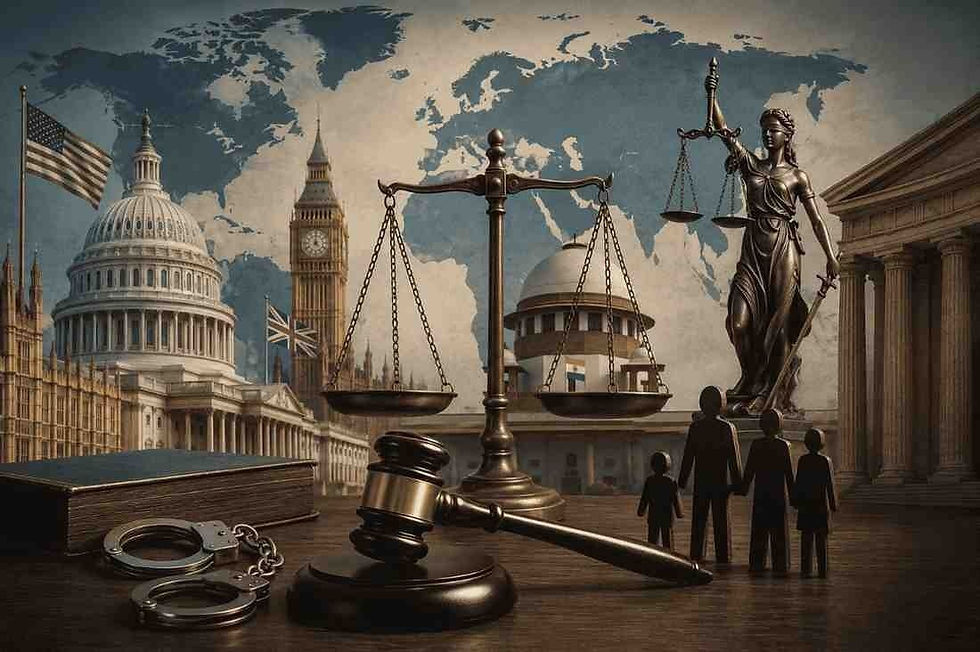
I. INTRODUCTION
Criminal law draws the line between conduct a society tolerates and conduct it punishes & names certain acts as offences and sets out what should follow when those lines are crossed. For a criminal justice system to have legitimacy, it has to do several things at once: investigate competently, prosecute without bias, hold trials that people can see and trust and deliver outcomes that feel just while protecting the victims and preserving the presumption of innocence, and maintaining public safety. When that balance holds it’s usually a fair indicator that the rule of law actually functions.
Cyber fraud, online harassment, and cross-border organised crime have outpaced older investigative tools. Meanwhile, the legacy problems remain: cases listed for years, undertrials forming the majority of prison populations, forensic labs with backlogs, and persistent calls for accountability from police and courts. Different countries have responded in different ways like the US debates sentencing reform and decarceration, while the UK relies heavily on sentencing guidelines, community orders, and a stronger procedural role for victims. Norway, Germany, Japan and the Netherlands have, in their own ways, pushed rehabilitation and reintegration to the centre of penal policy.
India’s answer came in 2023, Parliament repealed three colonial codes and enacted the Bharatiya Nyaya Sanhita, the Bharatiya Nagarik Suraksha Sanhita, and the Bharatiya Sakshya Adhiniyam. The BNS, BNSS and BSA replace the IPC, CrPC and Evidence Act[3]. On paper, the shift is clear: mandatory forensics in serious cases formal recognition of digital and electronic records structured victim participation community service for specified minor offences and a redrawing of offences affecting national security and sovereignty. The stated aim is a system that is contemporary, efficient, and victim-sensitive.
Statutes alone do not reform institutions. Court pendency runs into crores of cases. Most prisoners are still undertrials. Many police stations lack reliable connectivity or trained personnel to handle digital evidence. Forensic capacity is uneven across states. And the Constitution doesn’t go away. Articles 14, 20, 21 and 22 set the floor for fairness[4]. The practical test for the new codes is whether they can speed up justice without hollowing out those guarantees.
There is also a philosophical claim here: the 2023 framework tries to move the system’s centre of gravity. It keeps punishment, but makes room for restoration, victim agency, and science-led investigation. That’s a departure from a code drafted in 1860 for a different state and a different technology.
This study proceeds in five parts. First, it tracks the development of Indian criminal law from pre-colonial and Mughal practices, through the British codification, to post-1947 amendments. Second, it sets out the constitutional limits that govern criminal procedure today. Third, it examines the BNS, BNSS and BSA: the reasoning behind them, and what they change in practice for investigation, trial, evidence and sentencing. Fourth, it compares India’s choices with reforms in the United States, United Kingdom, and with rehabilitation-focused systems elsewhere. Finally, it identifies the main implementation bottlenecks and outlines measures that could make the new laws work on the ground.
The point of this paper isn’t to reproduce section numbers, It’s to ask a harder question: can these reforms cure long-standing failures of delay, fairness and access, and produce criminal justice that is efficient, constitutional, and humane.
II. HISTORICAL EVOLUTION OF CRIMINAL LAW IN INDIA
Indian criminal laws have not evolved in one continuous process but rather in an evolutionary manner characterized by different periods that have contributed uniquely to the current legal system. The ancient dharmic texts such as the Islamic jurisprudence of the Mughal period, the colonial codification under British rule and the constitutional transformation after independence together constitute the normative genealogy of Indian criminal justice.
A proper understanding of the Bharatiya Nyaya Sanhita, the Bharatiya Nagarik Suraksha Sanhita and the Bharatiya Sakshya Adhiniyam, 2023 therefore requires an appreciation of the legal structures that they supersede.
2.1 Criminal Law in Ancient India
The roots of criminal law in India may be traced to the classical legal and political texts such as the Manusmriti, Yajnavalkya Smriti, Narada Smriti, and Kautilya’s Arthashastra[5].
These sources did not merely catalogue offences in a mechanical sense, they conceived law as an instrument of social ordering, functionality, moral regulation, and public peace in order to create more dynamic structure in society which could be evolved over time. Central to this conception was the doctrine of (Danda) or punishment which was regarded as indispensable for the preservation of order and the prevention of social disintegration[6]. Kautilya’s Arthashastra is especially significant because it reveals a comparatively sophisticated theory of criminal administration. The king was considered the custodian of social harmony who was supposed to conduct inquiries into crimes, punish offenders, and enforce discipline through appropriate punishment. The passage seems to demonstrate that from the very beginning there were already efforts at establishing rules of evidence and procedure which imply that punishment had to be carried out in an organized way. At the same time, local assemblies and village-level institutions continued to play an important role in resolving ordinary disputes and maintaining fluidity. Thereby representing an early form of decentralized justice.
2.2 Criminal Law During the Mughal Period
There emerged many changes during the Mughal era due to the influence of the Islamic law on criminal administration. The entire procedure of dealing with cases of crime was governed by the Quran and the Hadith, there were judges referred to as qazis who handled matters of crime[7]. The system thus acquired a more formal religious jurisprudential structure though it was never entirely detached from prevailing customary practices. Offences during this period were generally classified into Hudud, Qisas, and Tazir. Hudud offences were treated as the most serious violations and attracted fixed punishments, whereas Qisas governed retaliatory liability in cases involving murder or bodily injury. Tazir represented the discretionary category under which the Qazi could determine punishment where no fixed religious sanction has ever existed[8]. The system had the advantage of institutional organization and had the backing of supreme authorities but it lacked a comprehensive and uniform written code and this naturally produced variation across regions and judicial officers.
2.3 Criminal Law During the British Period.
The colonial period introduced the most decisive shift in the history of Indian criminal law. British administrators regarded the coexistence of religious rules, customary practices, and local variations as incompatible with effective imperial governance. Their response was not plural accommodation but legal uniformity and this objective gave rise to the codification project led by the First Law Commission under Macaulay[9]. The Indian Penal Code, enacted in 1860, became the principal substantive criminal statute and remained the backbone of Indian penal law for more than a century and a half. Colonial rule also produced procedural and evidentiary standardization through the Code of Criminal Procedure and the Indian Evidence Act, 1872. These enactments introduced a high degree of predictability but they were fundamentally instruments of administrative control rather than emancipatory justice. Their design was shaped by the needs of colonial order, discipline, and political containment, further they codified them in order to maintain british control across the occupied territory[10] though they later became the basic legal scaffolding of the postcolonial state.
2.4 Criminal Law in Independent India.
Independence did not immediately displace the colonial penal framework. The IPC, CrPC, and Evidence Act continued to operate after 1947, but their authority was now subordinated to the Constitution of India, which introduced a radically different normative horizon. Fundamental rights, especially Articles 14 and 21, compelled the criminal justice system to justify state coercion in terms of equality, fairness, and personal liberty. Over time, through decisions by the Supreme Court and High Courts, several constitutional principles were evolved and implemented in areas relating to protection of individual rights during criminal procedure, fair trial, and custodial justice[11]. However, even constitutional doctrines alone could not remedy the malaise of procedural delays, crowded courts, poor investigation, and inefficiencies in the criminal justice process. This need was highlighted again and again through reports of several committees, including the Malimath Committee[12]. By the early twenty-first century, the old codes became irrelevant in handling cybercrime, organized crime, digital evidence, and the demands of a technologically complex society. Leading to the criminal law reforms in 2023.
III. CONSTITUTIONAL FRAMEWORK OF CRIMINAL JUSTICE IN INDIA
The Constitution of India acts as the Constitutional framework for the Indian criminal justice system. Criminal laws define offences and prescribe punishments for their violation. On the other hand, the Constitution makes sure that there is no overreach on the part of the State and also that individual rights are well protected. The Constitution therefore acts as a safeguard against arbitrary action and provides the standards against which criminal laws and criminal justice reforms are evaluated.
3.1 Equality Before Law and Equal Protection of Laws
Article 14 of the Constitution provides for equality before law and equal protection of laws for all persons[13]. The essence of this article lies in the fact that each and every person shall be treated equally regardless of his caste, religious beliefs, gender, social class, or any other characteristic. There should not be any kind of discrimination or rigidity in the order and the article makes sure that criminal justice institutions are not arbitrary and that criminal investigations, prosecutions and trials happen without any biasness. The provision therefore serves as an important constitutional check against abuse of power and discriminatory enforcement of criminal laws.
3.2 Constitutional Safeguards in Criminal Prosecution
Article 20 guarantees essential rights to those accused of criminal acts[14]. Article 20 ensures that no law should be made retrospectively that would turn an innocent act into crime that there shall not be two trials for the same offense and that nobody should be compelled to become witness against himself. These rights are guaranteed in order to make sure that individuals are treated justly and that powers are not exercised arbitrarily by the state. Article 20 plays an important role in securing the freedom of the individual by limiting the use of prosecution powers in specific cases.
3.3 Right to Life, Personal Liberty, and Fair Trial
Article 21 mentions that no individual shall be deprived of his life or liberty unless by due process of law[15]. The Indian Supreme Court, through various judicial decisions has widened the ambit of this Article, making it the crux of criminal law. In the case of Maneka Gandhi v. Union of India[16], the Supreme Court held that all procedures which result in the deprival of an individual’s liberty must be just, fair, and reasonable. Subsequently, the judiciary recognized several rights connected with criminal justice administration, including the right to a fair trial, legal aid, speedy trial, and protection against custodial abuse. Similarly, in case of Hussainara Khatoon v. State of Bihar[17], the Supreme Court stressed that the right to a speedy trial is an integral aspect of personal liberty and access to justice. This implies that the administration of criminal justice in India is not only about punishing the offenders but also respecting human dignity.
3.4 Protection Against Arbitrary Arrest and Detention
Article 22 is a provision which makes provisions for safeguards of the arrested person[18]. According to this section, the arrested individual must be informed about the reasons behind the arrest. He has the right to get the assistance of a legal practitioner and has to be presented before the court within twenty-four hours of the arrest. In D.K. Basu vs State of West Bengal[19], the Supreme Court laid down certain guidelines for preventing any kind of custodial violence on the part of the police and ensuring that the rights of arrested individuals are protected from the abuse of power.
3.5 Role of Judiciary in Strengthening Criminal Justice
The role played by judiciary has been highly significant in making criminal law procedures consistent with the principles and values enshrined in the constitution. Judiciary through its powers of judicial review and constitutional interpretation has succeeded in improving the procedural safeguards of criminal laws in such a way that the liberties and rights of both parties (accused and victim) are protected[20]. Through landmark decisions the judiciary has repeatedly emphasized fairness, flexibility and accountability and also establishing protection of liberty which is one of the essential components of criminal justice administration. This framework guarantees that the administration of criminal justice continues to be guided by democratic ideals and maintains order. The rule of law and fundamental rights. It is from such constitutional perspectives that recent reforms within the criminal law, like BNS, BNSS, and BSA, have to be assessed.
IV. JURISPRUDENCE BEHIND JUSTICE REFORMS IN INDIA
The reforms of 2023 represent a critical departure from the penal nature of criminal law that has been dominant in India until now and move toward a more constitutional and justice-oriented model. In other words, The Bharatiya Nyaya Sanhita, Bharatiya Nagarik Suraksha Sanhita, and Bharatiya Sakshya Adhiniyam cannot be considered mere revisions of existing legislation but an effort to bring the criminal laws into conformity with today’s constitutional values, social realities, and technological needs. This is apparent from the manner in which the new laws seek to move beyond mere punitive measures and focus on reforms, participation by victims, and procedural efficiency.
4.1 Decolonizing the Law: From Dand to Nyaya
One of the main aims of the new legislation is to remove colonial traces that existed in the old laws. The old Indian Penal Code (IPC), the Criminal Procedure Code (CrPC), and the Evidence Act were products of imperialism and were created more for administrative reasons than for protecting citizens’ rights. The new framework seeks to replace that inherited logic with one that is more consistent with constitutional democracy and Indian social conditions. A clear example is the treatment of sedition-like conduct. The focus is now on acts that genuinely threaten the sovereignty, unity, and integrity of India rather than on vague notions of disaffection against the government. In this sense, the new laws try to shift the criminal process from Dand as state-cantered punishment to Nyaya as justice grounded in legitimacy and proportionality.[21]
4.2 Reimagining Punishment: Rehabilitation and Strict Deterrence
The reform agenda also reflect as a new understanding of punishment. Whereas the previous model relied heavily on imprisonment, the new legislation acknowledges that some offenses do not necessarily need to be responded to by imprisoning an individual. Community service has since been incorporated as one way of punishing people for certain minor offences, signalling a move toward corrective and restorative approaches. This is important because it reduces unnecessary prison burden while keeping the penal response meaningful. At the same time the laws become stricter where social harm is greater. Offences against women and children are treated with enhanced severity, and minimum punishments have been raised for serious crimes. Organized crime is also recognized more clearly at the national level, which gives law enforcement a stronger statutory basis to respond to structured criminal networks. The reform is therefore not lenient in a general sense; rather, it is selective, reformative for minor offences and tougher for grave wrongdoing.[22]
4.3 Integrating Restorative Justice Mechanisms
Another important jurisprudential feature is the greater space created for restorative justice. The new regime gives greater emphasis to victim compensation, plea bargaining, and procedural mechanisms that can reduce delay and improve participation. These ideas reflect a broader understanding that the criminal justice process should seek to heal the harm and not merely punish the wrongdoer. Unfortunately even today there is institutional resistance. courts, law enforcement agencies, and lawyers have long been trained in adversarial habits and public opinion often equates justice with punishment alone. For restorative methods to work in practice, there must be training, pilot implementation, and stronger legal services structures at the local level. Without that, the reform remains doctrinally progressive but institutionally weak.[23]
4.4 Victim-Centricity and Inclusive Legal Drafting
The new laws also mark a serious move toward victim-centric criminal justice. Traditionally, Indian criminal trials treated the victim as a marginal witness while the real contest remained between the State and the accused. The new framework changes that position by giving the victim a more visible and protected role in the investigation and trial process[24]. This shift is also reflected in more inclusive drafting. The use of gender-neutral terminology such as ‘child’ helps to broaden terms that previously restricted legal rights.[25] While at the same time giving greater consideration to transgender and other marginalized groups. In jurisprudential terms, this is important because it moves criminal law closer to substantive equality rather than formal neutrality alone.
4.5 Modernizing Evidence and Scientific Investigation
The reform package is also driven by technological necessity. Older evidentiary rules were poorly suited to cybercrime, digital fraud, electronic records, and online abuse. The new evidentiary regime expressly accommodates electronic evidence, this emphasis on forensic science in procedural matters is also equally important. This prevents over-reliance on confession-based police work, which in turn allows investigations that are driven by evidence. Provisions such as Zero FIR further strengthen access to justice by allowing prompt reporting without technical jurisdictional barriers. Together these reforms represent a move from formal legality to practical enforcement capacity[26].
4.6 Implementation Hurdles and Constitutional Safeguards
Despite their promise, the new laws will create interpretive and administrative challenges. Courts will need to determine how far older precedents remain relevant under a substantially rewritten statutory structure. Police officers, prosecutors, and defence lawyers will also require training to understand new offences, procedures, and evidentiary rules. There is also a constitutional caution here. As investigative powers expand, safeguards under Article 21 must remain central so that efficiency does not become a cover for arbitrariness. The success of these reforms will depend not only on the text of the laws but also on infrastructure, training, and judicial sensitivity. In that sense, the new criminal laws are best understood as the beginning of a transition, not the completion of reform.[27]
V. IMPACT OF CRIMINAL LAW AMENDMENTS IN INDIA: AN ANALYSIS OF BNS, BNSS, AND BSA
The 2023 criminal law reforms are a landmark shift in India’s justice system because they replace the IPC, CrPC, and Indian Evidence Act with the BNS, BNSS, and BSA. But what matters more than anything else is that, through this amendment process, criminal law will not only incorporate changes to older rules, but also be recast in light of constitutional principles, victim rights, technology, and quicker proceedings. It is in this way that we can say the amendments are both symbolic and structural they seek to move the system away from colonial-era control and toward a more efficient, transparent and rights-aware framework.[28]
5.1 The Bharatiya Nyaya Sanhita (BNS): Redefining Substantive Offences and Reformative Justice
The BNS brings about the modernization of substantive criminal laws by incorporating several modern modes of crimes under the mainstream penal system. The BNS has specifically incorporated acts of terrorism, organized crime syndicates, and mob lynching that were otherwise covered through special laws and local laws. Thus, there will be more uniformity for the police and the prosecution. Not to mention the ease of establishing criminal liability across jurisdictions.
The BNS, moreover, modifies the crimes committed against women and children through the imposition of tougher penalties and the increased scope of drafting. It uses more encompassing wording, such as the substitution of “minor girl” with more gender-neutral terminology, including “child,” thus providing equal protection to both genders among the vulnerable population group of minors. Equally important, the act provides for community service as part of the punishment in cases of minor offenses, marking a shift in the philosophy of punishment from the purely retributivist approach. This is a major jurisprudential move because it recognizes that not every offence is best answered by incarceration.
One of the most controversial changes is the abolition of sedition as it was known under the colonial law. Under the reformed legislation, the emphasis will be on any act which is likely to endanger the sovereignty, integrity, and unity of India, as opposed to expressions of dissatisfaction with the government. That change seeks to preserve legitimate dissent while still allowing the state to respond firmly to genuinely dangerous acts.[29]
5.2 The Bharatiya Nagarik Suraksha Sanhita (BNSS): Procedural Efficiency, Technology, and Custodial Dynamics
The BNSS is the part of the reform that most directly affects everyday criminal justice practice because it governs arrest, investigation, trial and procedural safeguards. Its emphasis on timelines is especially important in a system long criticized for delay. The purpose of the law is to ensure that cases in court do not pile up by encouraging speedy disposal of the matter following any arguments made.
Moreover, BNSS will increase the usage of technology in the criminal procedure. The Bill allows the usage of e-FIRs, digital summons, electronic record keeping and video-conferencing for testimony and remand. These measures do not merely make it convenient to manage the paperwork. There might be practical advantages in increasing the accessibility for victims, securing the integrity of the files and avoiding any manipulation. In practice, it may also save time and lower the logistical burden on courts and witnesses.
While at the same time there are issues concerning detention and liberty by virtue of BNSS. There is the new custody regime that provides for more leeway in terms of time period, which will be helpful in cases of cybercrimes, but it also makes early bail and liberty protections harder to secure in some situations. That tension shows the larger challenge of the reform project: improving effectiveness without weakening constitutional safeguards under Article 21. Victim participation is also strengthened because the law requires updated communication on case progress, which helps correct the historic sidelining of victims.[30]
5.3 The Bharatiya Sakshya Adhiniyam (BSA): Digital Evidentiary Standards and Scientific Proof
The BSA is the evidentiary backbone of the reform package. Its central achievement is the strong recognition of electronic and digital records as primary evidence. In a world where crimes are planned through messaging apps, money moves through digital transfers and crucial events are captured on CCTV, this shift was necessary to prevent outdated evidentiary rules from defeating substantive justice.
The BSA’s treatment of server logs, GPS data, emails, and smartphone records strengthens the ability of courts to deal with modern crime. It also reduces technical loopholes that earlier allowed important digital proof to be excluded or challenged on formal grounds. Together with the BNSS, it also supports a greater forensic orientation, especially in serious offences carrying long sentences. The requirement to involve forensic teams and videograph search and seizure is a strong move away from confession-centric policing and toward objective, science-based investigation.
This is jurisprudentially significant because evidence law now better reflects the realities of digital life. It also promotes reliability and transparency in proof, which should improve both conviction quality and fairness to the accused. The challenge, however, is that evidentiary modernization only works if police and courts are trained to collect, preserve and present digital material correctly.[31]
5.4 Implementation Roadblocks: Infrastructural Deficits and the Dual Legal Regime
The biggest weakness of these reforms is not the legal text but the conditions of implementation. Forensic mandates will strain a system that still lacks enough laboratories, crime-scene units and trained experts. If those gaps are not filled, the promise of scientific investigation may turn into more delay rather than less.
Digital policing also depends on infrastructure that is uneven across India., This will only come to fruition if the government makes efforts for the same. Smaller rural stations may not have reliable internet facilities, updated devices, or adequate technical support. In such settings, e-FIRs and electronic records may remain aspirational unless the state invests in hardware, connectivity, and training[32]. This could cause a dual justice system created as a consequence, where larger cities will get all the benefits immediately, while rural areas will take some time to implement the same.
There is also the transitional problem of dual legal regimes. Offences committed before the new laws came into force must still be handled under the old framework, while later offences fall under the BNS, BNSS, and BSA.[33] That overlap complicates litigation, increases interpretive confusion and requires constant cross-referencing by judges and advocates. For a period, therefore the system may become more complicated before it becomes simpler.
5.5 Constitutional Imperatives: Balancing Expanded State Power with Civil Liberties
The reforms must also be judged by how well they preserve liberty while expanding efficiency. Any increase in police power, digital surveillance, or custody flexibility has to remain consistent with Article 21 and the broader constitutional commitment to due process. The new laws can strengthen criminal justice only if they are applied with restraint, accountability and judicial oversight.
That balance is what makes the reforms jurisprudentially important. They do not simply update code sections; they ask Indian criminal law to rethink its basic priorities: how to define crime, how to investigate it, how to prove it, and whom the system is ultimately meant to serve. Their success will depend on whether the state matches legal reform with institutional capacity, technical readiness and constitutional discipline[34].
5.6 Concluding Assessment: Legislative Ambition Versus Institutional Reality
Overall, the BNS, BNSS, and BSA represent one of the most ambitious criminal law transformations in independent India. They modernize offences, streamline procedure, and make evidence law compatible with digital life. They also move the system toward victim orientation, reformative punishment and scientific investigation.
Yet their long-term impact will depend less on legislative ambition and more on implementation. If infrastructure, training and oversight improve, These laws could truly be able to ensure that there is a much faster and more efficient criminal justice system. However, if the conditions above are not fulfilled, then there will be an excellent legal doctrine with poor implementation.[35]
VI. COMPARATIVE STUDY OF CRIMINAL JUSTICE REFORMS IN US, UK AND OTHER COUNTRIES
The criminal justice system all around the world has experienced change as a result of three major influences: digital crime, procedural delay and demands for greater fairness and accountability. The governments themselves have come under criticism for overcrowded prisons, unequal justice and lack of victim participation. In this context, criminal law reform is no longer only about punishment; it is also about efficiency, rights protection and institutional trust.[36]
India’s Bharatiya Nyaya Sanhita, Bharatiya Nagarik Suraksha Sanhita and Bharatiya Sakshya Adhiniyam represent a comprehensive attempt to modernize substantive law, procedure, and evidence together. The United States and the United Kingdom have taken different routes, but they too have increasingly moved toward rehabilitation, technology and victim-centred justice.[37] A comparison of these systems shows both convergence and important differences in reform philosophy.
6.1 India: Comprehensive Statutory Overhaul and Digital Modernization
India’s criminal law reform is distinctive because it replaces the country’s principal criminal statutes rather than merely amending them. The BNS modernizes the definition of crime by recognizing categories such as organized crime and terrorism within the core penal framework. Moreover, there is a provision for community service for some of the offences, which indicates that there has been a movement from the principle of total punishment to rehabilitation.[38]
The BNSS caters to the process of criminal law, seeking to reduce delay, improve transparency, and engage victims. This legislation provides for the use of e-FIRs, electronic summonses, recording of crime locations using videography and more electronic record-keeping of the administrative process.[39] On the other hand, the BSA attempts to modernize the laws governing evidence, making it recognize electronic records as legally valid, which is extremely significant for contemporary offences.[40]Together, these reforms aim to make criminal justice more efficient, technologically compatible and procedurally disciplined.
6.2 The United States of America: Targeted Decarceration and Structural Corrections
The USA’s, criminal justice reforms have typically occurred through selective legislative adjustments instead of replacing the current legal system with an entirely new statute. An important focus in this regard has been that of de-incarcerating the mass number of people held in jail and reconsidering sentencing practices. One notable example would be the First Step Act because it expands rehabilitation opportunities, supports sentence reduction in some cases, and reflects a growing concern with over-incarceration.
A second area where there has been significant reform is that of bail policy. In several states, the cash bail system has been scrapped owing to its inequitable effects on poor defendants. This is part of a general trend of ensuring fairness and equality, as well as taking into consideration the practicality of the fact that a person’s freedom should not be determined by his/her ability to pay for it. At the same time, reforms in police accountability and prison oversight show increasing attention to constitutional safeguards and correctional conditions.
The American approach stresses the importance of changes in sentencing policy, release from prisons and institutional responsibility rather than the total restructuring of laws. It does not seek a revolution in the system but correction of structural problems.[41]
6.3 The United Kingdom: Sentencing Consistency and Community Sanctions
Institutionalization of the process is more evident in the United Kingdom in respect to its policies concerning sentencing and rehabilitation. This has been made possible through the guidance provided by the Sentencing Council, which helps achieve fairness, proportionality, and predictability when making decisions on punishment. This helps reduce arbitrary variation and strengthens public confidence in judicial decision-making.
Community sentences, which include probation, curfew, electronically-monitored curfew and rehabilitation orders, are also applied in the United Kingdom. The reason why this type of sentencing is popular in the United Kingdom lies in the notion that it will ease the burden of imprisonment as well as rehabilitate the offenders for the benefit of the society. This reflects a practical understanding that short custodial terms often do little to reduce reoffending.
The modernization of technology can be seen in the field of digital policing and electronic record keeping systems. In addition, victim protection has become increasingly important, with stronger procedural support and more attention to the victim’s role in the justice process. Compared with the United States, the U.K. tends to combine reform with greater institutional coherence and stronger sentencing guidance.[42]
6.4 Global Perspectives: Alternative Models of Rehabilitative and Restorative Justice
Looking beyond these three jurisdictions, several countries offer useful reform models. In Norway, there is a correctional program that emphasizes rehabilitation rather than punishment. Education and training programs are used to reintegrate the offenders back into the community.[43] The German correctional system emphasizes constitutional rights, proportionality and judicial review for achieving the ideal balance between the powers of the government and the freedoms of citizens.[44] The Japanese correctional system emphasizes discipline, social reintegration and community participation, which leads to low levels of recidivism.[45] The Netherlands has increasingly relied on restorative justice and non-custodial sanctions to reduce dependence on imprisonment.[46]
The significance of these approaches is that they prove the possibility to design a criminal justice system based on rehabilitation and reintegration rather than punishment. It should also be mentioned that the success of such reforms does not depend solely on the legislation passed but also depends on institutional culture.[47] In comparative terms, they widen the range of possibilities available to policymakers in India, the U.S., and the U.K.
6.5 Comparative Synthesis: Technological Convergence and Legislative Divergence
When India, the United States and the United Kingdom are compared, several common themes emerge. First, all three systems are increasingly using technology in investigation, recordkeeping and trial management. India’s recognition of digital evidence and procedural digitization is comparable to similar technological shifts in the U.S. and U.K. Second, all three jurisdictions are paying more attention to victims, especially through procedural safeguards, transparency and participation.
The differences are equally significant. The United States has focused most heavily on mass incarceration, sentencing reform, and police accountability. The United Kingdom has emphasized sentencing consistency, community sanctions and rehabilitation. India. By contrast, has undertaken a far broader legislative reset by replacing its three foundational criminal law statutes at once. That makes the Indian reform project more sweeping in legal scope, even if implementation remains more uncertain.
The introduction of community service in India also brings it closer to reform models used in the U.K., the Netherlands, and Norway. In this context, what is noteworthy is that it marks a trend where there appears to be a definite shift in terms of Indian criminal law jurisprudence. There is an obvious movement in all jurisdictions towards proportionality, restitution, and rehabilitation, rather than punishing the offender for his crimes.
6.6 Implementation Barriers: Infrastructural and Institutional Realities
Despite all this, however, implementation remains critical. In India, for instance, implementation of the new laws will depend on the presence of forensic labs, technological capability, and training of police officers, prosecutors, and judges. Otherwise, the dream of scientific investigation and technological court hearings may not become a reality. The problems that the U.S. struggles with include those of racial discrimination, crowded prisons and state reforms. In the UK, there are challenges in its prisons, legal aid provision and correctional resources.
The common problems that arise prove that legislation alone is not enough to change criminal justice. It takes institutional capability, administrative discipline and political commitment for reform to take place. It also requires ongoing evaluation so that laws do not remain progressive only on paper. In all three countries, the central challenge is the same: turning reform into practice.
6.7 Conclusion: The Trajectory Toward Humane and Efficient Justice
The comparative study shows that India, the United States and the United Kingdom are converging on several reform goals, especially digitization, victim participation and rehabilitation. Yet they differ in scale and method. India has chosen comprehensive legal replacement, the United States has pursued targeted correction of punitive excesses and the United Kingdom has emphasized consistent sentencing and community-based alternatives. Together, these approaches demonstrate that modern criminal justice reform is no longer defined only by punishment, but by the search for a system that is efficient, fair and humane.
VII. CONCLUSION
The criminal justice system is basically the backbone of any democracy. It keeps order, protects our rights and makes sure the rule of law actually means something. In India, this system has been shaped by a long history from ancient legal traditions, to Mughal-era Islamic jurisprudence, to the big legal codes the British left behind. The 2023 rollout of the Bharatiya Nyaya Sanhita (BNS), Bharatiya Nagarik Suraksha Sanhita (BNSS), and Bharatiya Sakshya Adhiniyam (BSA) is the boldest attempt so far to drag those colonial-era laws into line with our Constitution’s values.
What this study shows is that these new laws are trying to fix the slow, messy parts of our justice system. By bringing tech into the process, accepting electronic evidence and making scientific investigation mandatory, the goal is to pull criminal law into the digital era. This is due to the fact that including topics like community service, victim’s rights and concern for vulnerable sections demonstrates that the focus on solving the problem has been made rather than just penalizing the offenders.
But speed and tech can’t come at the cost of basic rights. The wider powers in these new laws have to square with Articles 14, 20, 21, and 22 of the Constitution. Efficiency means nothing if it tramples due process, liberty, or equality. So the courts will have a huge job: interpreting these laws so that getting things done faster doesn’t mean cutting constitutional corners.
Globally, India’s move fits a bigger pattern. Countries everywhere are going digital, exploring restorative justice and looking for ways to avoid locking up too many people. The US has focused on targeted decarceration, the UK on consistent sentencing rules, but India went for a full statutory overhaul. Places like Norway, Germany and the Netherlands show that real, lasting justice depends on helping offenders reintegrate and holding institutions accountable.
At the end of the day, these laws will be judged by how they work on the ground, not how they read on paper. We’ve got real hurdles: not enough forensic labs, patchy internet access overloaded courts, and the massive task of training everyone involved. Success won’t be measured by passing the BNS, BNSS, and BSA. It’ll be measured by whether people actually get justice that’s fast, transparent and fair. If we back these reforms with strong institutions and a constant respect for constitutional rights, they could rebuild public trust and bring India’s criminal justice system into the modern age.
VIII. RECOMMENDATIONS AND SUGGESTIONS
To make sure these new laws don’t just look good on paper, here are some suggestions:
1. Strengthening Forensic Infrastructure: The BNSS requires forensic investigation for serious crimes, so we need that infrastructure now. That means more high-end regional forensic labs and a serious push to recruit and train forensic experts, or cases will just get stuck.
2. Comprehensive Stakeholder Training: Police, prosecutors, judges, and lawyers all need ongoing, hands-on training for the new framework. They have to know how to collect, store and present digital evidence and how the new tech-driven procedures actually work.
3. Bridging the Digital Divide in Legal Tech: E-FIRs, electronic summons and digital records can only operate if the technology is available everywhere. There must be stable internet connectivity, secured databases and proper cybersecurity measures both in towns and villages. Otherwise, justice would be dependent upon one’s pin code.
4. Ensuring Strict Constitutional Oversight: As agencies obtain technological instruments, strict oversight is essential to make sure that issues such as privacy and personal freedom are not compromised. Procedures should be tight enough that Articles 14, 20, 21, and 22 aren’t just footnotes.
5. Institutionalizing Victim Support Services: Letting victims participate on paper isn’t enough. We need actual support services, faster compensation tribunals, and access to counselling and legal aid right from the start of a case.
6. Expanding Restorative and Community-Based Sanctions: To cut down on overcrowded jails, courts and police should actually use the new community service provisions. Plea bargaining and mediation for less serious crimes should be expanded too. It is supposed to aid people’s reintegration, not punish them.
7. Augmenting Judicial and Administrative Capacity: The BNSS imposes stringent deadlines, which will be impossible to achieve in case there are not enough court personnel. We need to appoint judges, establish fast track courts and increase the number of support staff.
8. Establishing Statutory Review Mechanisms: A review committee comprising of judges, scholars and law enforcers should be put in place to periodically evaluate the new statutes, hence ensuring that Parliament addresses any issues at an early stage through credible information.
9. Contextualizing International Best Practices: We ought to be watchful about Norway’s concentration on rehabilitation, UK’s consistency in sentencing, and the US’ accountability programs. But none of that works unless we tailor it to India’s social and economic realities.
10. Advancing Public Legal Literacy: Finally, run nationwide awareness campaigns. If citizens don’t know about the new rights, duties and protections under BNS, BNSS and BSA, the laws can’t empower them. A legally aware public is part of the reform.
[1]Ashworth, A. (1991). Principles of criminal law. Oxford University Press.
[2]National Judicial Data Grid (NJDG)
[3]Bharatiya Nyaya Sanhita, 2023
Bharatiya Nagarik Suraksha Sanhita, 2023
Bharatiya Sakshya Adhiniyam, 2023
[4]The Constitution Of India, 1950
[5]Kautilya. (1915). Kautilya's Arthashastra (R. Shamasastry, Trans.). Government press., Manu. (1886). The laws of Manu (G. Bühler, Trans.; F. Max Müller, Ed., Vol. 25). Oxford University Press., Kane, P. V. (1930–1962). History of Dharmaśāstra (Ancient and Mediaeval Religious and Civil Law in India) (Vols. 1–5). Bhandarkar Oriental Research Institute.
[6]Kautilya. (1915). Kautilya's Arthashastra (R. Shamasastry, Trans.). Government press.
[7]Sarkar, J. (1920). Mughal administration. M. C. Sarkar & Sons.
[8]Coulson, N. J. (1964). A history of Islamic law. Edinburgh University Press.
[9]Early Beginnings: Law Commission of India. India. (n.d.). https://lawcommissionofindia.nic.in/about-department/early-begginnings/
[10]Baxi, U. (1982). The crisis of the Indian legal system. Vikas Publishing House.
[11]Jain, M. P. (2025). Indian constitutional law (9th ed.). LexisNexis.
[12]Committee on Reforms of Criminal Justice System. (n.d.). https://www.mha.gov.in/sites/default/files/2022-08/criminal_justice_system[1].pdf
[13]The Constitution Of India, 1950
[14]The Constitution Of India, 1950
[15]The Constitution Of India, 1950
[16]AIR 1978 SC 597
[17]AIR 1979 SC 1369
[18]The Constitution Of India, 1950
[19]AIR 1997 SC 610
[20]The Constitution of India, 1950, Article 32 and 226
[21]Parliament of India Rajya Sabha. (n.d.-b). https://prsindia.org/files/bills_acts/bills_parliament/2023/SC_Report_Bharatiya_Nyaya_Sanhita_2023.pdf
[22]Parliament of India Rajya Sabha. (n.d.-b). https://prsindia.org/files/bills_acts/bills_parliament/2023/SC_Report_Bharatiya_Nyaya_Sanhita_2023.pdf
[23]Committee on Reforms of Criminal Justice System. (n.d.-a). https://www.mha.gov.in/sites/default/files/criminal_justice_system.pdf
[24]Committee on Reforms of Criminal Justice System. (n.d.-a). https://www.mha.gov.in/sites/default/files/criminal_justice_system.pdf
[25]Parliament of India Rajya Sabha. (n.d.-b). https://prsindia.org/files/bills_acts/bills_parliament/2023/SC_Report_Bharatiya_Nyaya_Sanhita_2023.pdf
[26]Parliament of India Rajya Sabha. (n.d.-d). https://prsindia.org/files/bills_acts/bills_parliament/2023/SC_Report_Bharatiya_Sakshya_Bill_2023.pdf
[27]Committee on Reforms of Criminal Justice System. (n.d.-a). https://www.mha.gov.in/sites/default/files/criminal_justice_system.pdf
[28]Parliament of India Rajya Sabha. (n.d.-e). https://prsindia.org/files/bills_acts/bills_parliament/2023/SC_Report_Bharatiya_Nyaya_Sanhita_2023.pdf
[29]Parliament of India Rajya Sabha. (n.d.-e). https://prsindia.org/files/bills_acts/bills_parliament/2023/SC_Report_Bharatiya_Nyaya_Sanhita_2023.pdf
[30]Parliament of India Rajya Sabha. (n.d.-c). https://prsindia.org/files/bills_acts/bills_parliament/2023/SC_Report_Bharatiya_Nagarik_Suraksha_Sanhita_2023.pdf
[31]Parliament of India Rajya Sabha. (n.d.-d). https://prsindia.org/files/bills_acts/bills_parliament/2023/SC_Report_Bharatiya_Sakshya_Bill_2023.pdf
[32]Parliament of India Rajya Sabha. (n.d.-d). https://prsindia.org/files/bills_acts/bills_parliament/2023/SC_Report_Bharatiya_Sakshya_Bill_2023.pdf
[33]The Constitution Of India, 1950, Article 20(1).
[34]Justice JS verma committee. (n.d.-c). https://spuwac.in/pdf/jsvermacommittereport.pdf
[35]Committee on Reforms of Criminal Justice System. (n.d.-b). https://www.mha.gov.in/sites/default/files/2022-08/criminal_justice_system[1].pdf
[36]Introduction criminal justice assessment toolkit. (n.d.-c). https://www.unodc.org/documents/justice-and-prison-reform/cjat_eng/CJAT_Toolkit_full_version23Mar10all.pdf
[37]Handbook on restorative justice programmes second edition. (n.d.-c). https://www.unodc.org/documents/justice-and-prison-reform/20-01146_Handbook_on_Restorative_Justice_Programmes.pdf
[38]Handbook on the bharatiya Nyaya Sanhita, 2023. (n.d.-d). https://bprd.nic.in/uploads/pdf/Final_BNS.pdf
[39]Handbook on the Bharatiya nagarik suraksha sanhita, 2023. (n.d.-d). https://bprd.nic.in/uploads/pdf/Final_BNSS.pdf
[40]Handbook on the bharatiya Sakshya Adhiniyam, 2023. (n.d.-f). https://bprd.nic.in/uploads/pdf/Final_BSA%20Book.pdf
[41]115.Sxxx Revised First Step Act of 20181.PDF. (n.d.-a). https://www.judiciary.senate.gov/imo/media/doc/115.Sxxx%20REVISED%20First%20Step%20Act%20of%2020181.pdf
[42]Definitive guideline imposition of community and custodial sentences. (n.d.-d). https://sentencingcouncil.org.uk/media/malhsauf/archived-imposition-of-community-and-custodial-sentences-definitive-guideline.pdf
[43]https://streamlinehq.comX, X. S. I. (n.d.). About the Norwegian Correctional Service. Kriminalomsorgen.no. https://www.kriminalomsorgen.no/about-the-norwegian-correctional-service.6327382-536003.html
[44]Act on the execution of prison sentences and measures of reform and prevention involving deprivation of liberty (prison act). (n.d.-b). https://www.gesetze-im-internet.de/englisch_stvollzg/
[45]White paper on crime. The Ministry of Justice:White Paper on Crime. (n.d.). https://www.moj.go.jp/EN/housouken/houso_hakusho2.html
[46]127(6
)520
7+(
),(/’ Dutch developments: Restorative justice in. (n.d.-b). https://restorativejustice.nl/wp-content/uploads/dutch-developments-restorative-justice.pdf
[47]Introduction criminal justice assessment toolkit. (n.d.-c). https://www.unodc.org/documents/justice-and-prison-reform/cjat_eng/CJAT_Toolkit_full_version23Mar10all.pdf


